

By David Henderson · 6-minute read
I spent 25 years running SEO at a scale most agencies never touch — national training programs for AutoTrader and Yellow Pages, enterprise and franchise work for Honda, Canadian Black Book, StarTech.com, Skedaddle, Truly Nolen, Weed Man, Handyman Connection, and dozens of other franchise systems across North America. None of that experience is what’s dying. The retainer it was packaged inside is what’s dying. The agencies that make it through this transition won’t be the ones who bolt an “AI-powered” label onto the same deliverables — they’ll be the ones who already have the operational discipline AI integration actually requires, and who stop calling it SEO.
What actually killed the SEO retainer?
Not keywords. Not search volume. Not Google. The retainer model sold activity — content produced, links built, reports delivered on a schedule — because activity was the only thing that was expensive and slow enough to justify a monthly invoice. A client never wanted a content calendar. They wanted leads, visibility, and a phone that rang. SEO was the lever available to pull. The moment production got cheap — AI writes the draft, audits the headings, drafts the meta description — the lever didn’t disappear. The labour wrapped around it did.
I called this out on this site back in August: my agency is already dead, in the sense that the thing people were paying for — the labour — doesn’t hold its price anymore. I watched a version of this happen once before, during the print-to-digital transition at AutoTrader. The operators who survived that shift weren’t the ones who defended the old format. They were the ones who moved to where the actual client problem was.
Why is AI consulting the same skill set as SEO, not a different one?
This is the part most agency owners get wrong, and it’s worth stating plainly: running AI integration for a client is not a new discipline bolted onto SEO. It is the exact same discipline, aimed at a wider scope.
Franchise SEO at scale means building hub-and-spoke site architecture that holds up past a certain location count, writing a governance rulebook that stops forty different writers — or forty different model runs — from inventing their own version of a licensing claim, and auditing structural problems across hundreds of pages in one pass without missing the ones a human skim would catch. That is the entire job of installing AI responsibly inside a business: map the workflow, find the slice that’s actually automatable, build the governance that stops a model from hallucinating a client-facing claim, and instrument what you’re going to measure before you turn it on.
I’m not describing this in the abstract. I’ve been documenting the real version of it on this site: the week my own orchestrator started ignoring its preflight instructions and why that turned out to be a control problem, not a prompting problem; the live hub page audit that found a year of orphaned headings nobody had noticed; the production pipeline that looked fine against a clean test file and then broke on the first real vendor payload, and what it took to actually fix it. That’s the same muscle as a 200-page technical audit. It’s just aimed at a client’s internal operations instead of their website.
 What does an agency actually need to change to make this pivot?
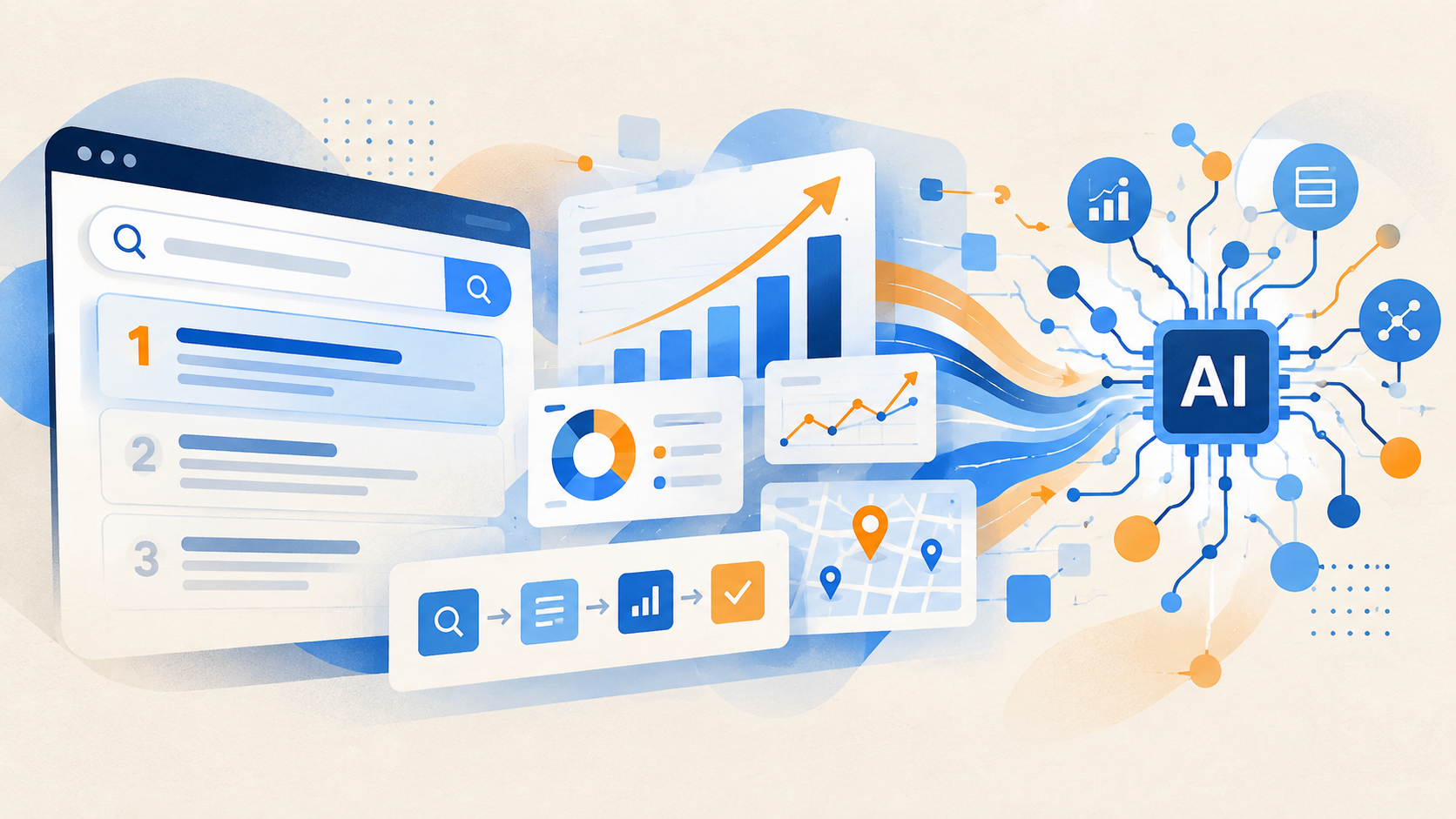
Here’s the opinion, stated plainly: most agencies are going to try to repackage their existing retainer with an “AI-powered” sticker on it, and it’s going to read as hollow, because it is hollow. A content package with an AI label is still a content package. The pivot that actually holds up is a different deliverable entirely — a workflow audit that maps where a business’s time actually goes, a system build that automates a specific piece of it, a trained team that can run what got built after the consultant leaves. That’s a different conversation than “we’ll use ChatGPT for your blog posts now.”
The differentiator isn’t a slide deck about AI. It’s operational scars — something you built yourself, that broke in a specific, nameable way, that you fixed and can describe in detail. An agency that can’t point to something it actually built and broke with AI in production is selling a guess with a retainer attached. Generic AI-hype content is exactly what language models absorb and summarize without sending anyone back to the source. First-person operational detail — the tool, the version, the date, the cost, the failure — isn’t something a competitor can repeat or a summarizer can flatten into a paragraph.
What does this look like for a multi-location or franchise client specifically?
This is where the franchise SEO background stops being a résumé line and starts being the actual product. A governance list that holds the line on which services and locations get pages, instead of forty unmanaged pages appearing over two years, is the same document structure a franchise system needs before it lets any AI tool touch client-facing content across its locations. A content claims rulebook that prevents a writer from inventing licensing language is the same rulebook that prevents a model from doing it faster. The discipline transfers directly. The scope is what changes — from “rank this page” to “make sure this business’s AI usage doesn’t say something ungoverned to forty different audiences at once.”
The next step, for an agency actually considering this
Start where I started: build and break something yourself before you sell it. Pick one real internal workflow — your own reporting, your own content QA, your own client onboarding — and automate a genuine slice of it. Write down what broke. That document is worth more to your next AI-consulting pitch than any amount of market research about where AI is headed.
Subscribe to the newsletter for the rest of this build log, published weekly.
Frequently asked questions
Is AI replacing SEO?
No. AEO and GEO — answer-engine and generative-engine optimization — are expansions of SEO, not replacements for it. The discipline of structuring, governing, and measuring content is what makes a business visible to an AI answer engine the same way it made a business rank in search. What’s dying is the retainer model built around selling labour, not the discipline itself.
Should my SEO agency add AI consulting as a service?
Only if you can back it with something you actually built. Adding an “AI-powered” label to an existing content package isn’t AI consulting — it’s the same service with new marketing copy. Real AI consulting starts with a workflow audit of the client’s actual operations, not a feature added to a retainer.
What’s the difference between an AI-powered SEO package and AI consulting?
An AI-powered SEO package uses AI to produce the same deliverables faster or cheaper. AI consulting is a distinct engagement: mapping where a business’s time actually goes, identifying what’s automatable versus what needs a human, and building or training the system that does it.
How do I know if my agency is ready to make this pivot?
If you can’t describe something you built with AI that broke, how you found the cause, and how you fixed it — in specific, nameable detail — you’re not ready to sell it to a client yet. Start internally first.
Does this mean traditional SEO work disappears?
No. The structural and governance skills behind good SEO — architecture, claims governance, measurement — are precisely what responsible AI integration requires. The work expands into a wider scope; it doesn’t get discarded.