
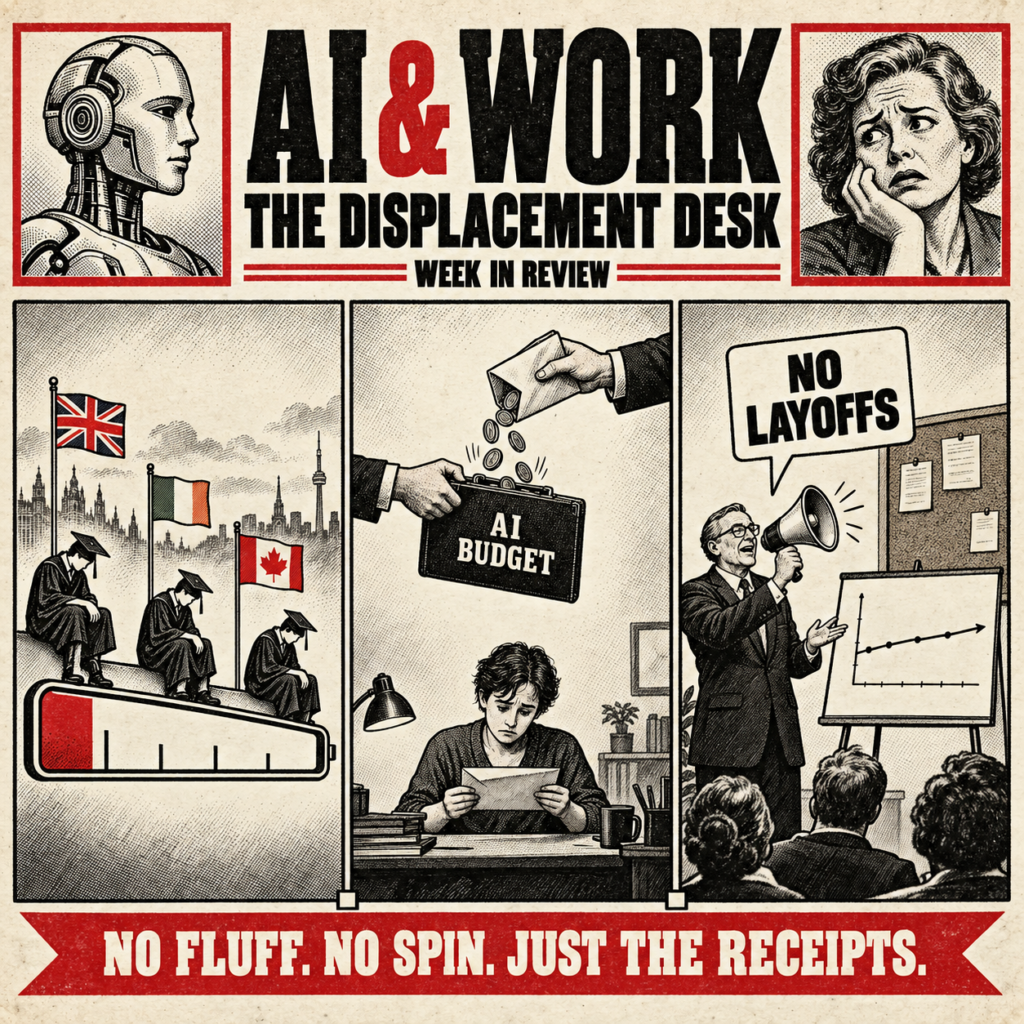
Why your paycheque might be the layoff nobody announced.
By David Henderson • Unwired Web Solutions • Updated September 2026 • 13-minute read
|
BOTTOM LINE I went looking for the AI jobpocalypse everyone keeps promising. I didn’t find it. What I found instead is arguably worse if you’re twenty-four: nobody’s getting a pink slip, but wage growth for AI-exposed workers is quietly getting starved, and the bottom rungs of the career ladder are disappearing before anyone even gets hired onto them. No headline. No press release. Just a slower raise and a job posting that never went up. |
|---|
The direct answers, no hedging
-
Is AI causing mass layoffs right now? No — not at the scale the doom threads promise. Companies are citing AI in roughly a quarter of announced cuts, but total layoffs are actually down 41% year over year.
-
So what’s actually happening? Three things, in order of how visible they are: wages for AI-exposed workers are growing slower, junior hiring is drying up, and the bar to get hired at all keeps rising.
-
Who’s eating this? Early-career workers and anyone in a highly digitized, routine-heavy job. Not senior staff. Not yet.
-
What are most employers actually doing? Retraining people, not firing them — by a wide margin, per the New York Fed’s own survey data.
-
How sure am I about the AI part specifically? Sure enough to publish it. Not sure enough to claim I’ve isolated AI as the sole cause — nobody honest can claim that yet, and I’ll show you exactly where the evidence stops.
The receipts
| Signal | Finding | What it actually proves |
|---|---|---|
| U.S. wage growth | High-AI-exposure occupations saw wage growth 6.7 percentage points slower after 2023 than low-exposure occupations, per Apollo Global’s study. | A real, measured wage effect — not proof AI alone caused every point of it. |
| U.S. job cuts | Through July 2026, announced cuts were down 41% year over year — but AI was explicitly cited in about 24% of them. | No broad layoff wave. A meaningful chunk of the cuts that are happening still get an AI label. |
| Employer response | 34% of AI-using service firms and 22% of manufacturers reported retraining; only 4% and 0% reported layoffs. | Retraining is the default move right now, not firing. |
| UK entry level | Graduate postings down 7% year over year; AI now appears in 9.4% of job ads. | Fewer first rungs on the ladder, right as AI-skill demand spikes. |
| Ireland youth tech | ICT employment among under-30s fell by almost one-third from 2023 to 2025; the sector overall fell 10.7% year over year in Q1 2026. | One of the sharpest early-career contractions in any developed tech market I’ve seen cited. |
| Canada youth labour | Youth unemployment hit 14.7% in September 2025. | A brutal entry market — though this number alone isn’t an AI-specific measurement. |
What I mean by “the quiet AI squeeze”
I’m defining these three terms plainly, because the vague version of this argument is useless to anyone trying to actually plan around it.
Wage suppression
A slowdown in wage growth for workers in roles with high exposure to AI-enabled automation. Not a pay cut — slower growth. That distinction matters, and I’m not going to pretend it doesn’t.
Entry-level erosion
A contraction in graduate, junior, and entry-tier openings as employers automate the baseline tasks those roles used to exist for, leave vacancies unfilled, or simply expect a new hire to show up more technically fluent than they used to.
Task redesign
What a job actually contains changes. AI strips out the routine parts and piles on more judgment, review, client communication, and tool supervision instead.
The layoffs-versus-wages trade — and why I think it’s the real story
Every debate about whether AI is “really” costing jobs asks the wrong question, because it assumes a company that wants to cut cost has exactly one lever: firing people. That’s not how any operator I’ve ever worked with actually thinks. Layoffs are expensive and embarrassing — severance, morale, the institutional knowledge that walks out the door, the headline nobody wants. Slowing someone’s raise is quiet, cheap, and invisible in the statistics everyone’s staring at.
Apollo Global’s July 2026 paper is the best evidence I’ve seen for this. They used Anthropic’s own Economic Index — real, observed Claude usage mapped against 321 occupations — and ran a proper difference-in-differences design against U.S. labour data, not a vibes-based guess. The finding: after 2023, workers in the highest-AI-exposure occupations saw their wages grow 6.7 percentage points slower than everyone else. That’s not a rounding error.
|
WHAT THIS DOES AND DOESN’T PROVE 321 occupations, a real difference-in-differences design, and a gap that gets consistently worse the lower you go down the wage ladder — that’s a measured pattern, not a guess. What it doesn’t prove is that AI alone caused every point of that gap; the broader economy moved through the same window. I’m not going to claim more certainty than the data supports, and neither should anyone selling you an AI panic. |
|---|
And the distribution makes it worse, not better: the wage-growth gap was 10.7% in the bottom quartile, 5.4% in the second, 4.0% in the third, and not statistically significant at all in the top quartile. The workers who could least afford it took the biggest hit. The highest earners barely felt it.
Why “no mass layoffs” doesn’t mean “no disruption”
If your entire test for AI disruption is “are announced layoffs spiking,” you’re using the wrong instrument — and I think a lot of the “AI panic is overblown” commentary is making exactly that mistake.
Challenger, Gray & Christmas tracked 477,033 U.S. job-cut announcements through July 2026 — 41% fewer than the same period in 2025, with hiring plans at their best January-to-July total since 2023. On its own, that’s a genuinely reassuring number. But 112,713 of those cuts — roughly 24% — cited AI explicitly. A quarter of all corporate layoffs this year came with an AI label stapled to the press release, even while the total number went down. Both things are true at once, and pretending otherwise in either direction is dishonest.
The missing first rung
Junior hiring can quietly die before a single existing employee gets cut, and it barely shows up in the statistics everyone watches — because those numbers only count people who got hired and then let go, not people who were never given the shot in the first place.
| Market | Latest signal | My read |
|---|---|---|
| United Kingdom | Graduate postings were 7% lower year over year as of July 10, 2026, and at their weakest seasonal level since 2020. AI appeared in a record 9.4% of UK postings at the end of June. | A clear entry-level squeeze with a rising skill bar — though broader UK hiring softness is part of this too. |
| Ireland | ICT employment among under-30s fell by almost one-third from 2023 to 2025; the overall sector fell 10.7% year over year in Q1 2026. | The sharpest sector-specific warning sign in this whole report, in a market that’s disproportionately exposed to multinational tech. |
| Canada | Unemployment among people aged 15–24 reached 14.7% in September 2025, the highest September rate since 2010 excluding 2020. | A genuinely severe youth labour problem — I’m not going to claim this one number proves AI displacement on its own. |
|
WHAT THIS EVIDENCE CAN — AND CAN’T — SAY I’m not going to tell you these three numbers add up to one global AI effect. They don’t, on their own — interest rates, post-pandemic normalization, sector cycles, and general hiring caution are all real factors too. What I will tell you is that three separate labour markets are all pointing the same direction at the same time, and that’s worth taking seriously even without one tidy unifying number to point to. |
|---|
The retraining majority — the part that should annoy both the doomers and the boosters
This is the part of the evidence that complicates the simplest version of the AI-doom story. In the New York Fed’s August 2026 regional survey of businesses in New York and northern New Jersey, 61% of service firms and 51% of manufacturers reported using AI. Among those users:
-
34% of service firms and 22% of manufacturers reported retraining employees in response to AI.
-
Only 4% of service firms and zero manufacturers reported AI-related layoffs.
-
Some firms cut hiring because of AI; others hired people specifically to help deploy or run it.
This is regional survey data, not a national census, so I’m not going to oversell it — but it points to the dominant near-term playbook: change the work before you change the workforce. Train the people you already have to supervise the tools, handle the exceptions, and take on more.
The three-layer framework I actually use to read a client’s real exposure
| Layer | Mechanism | What I watch for |
|---|---|---|
| 1. Headcount | Layoffs, attrition, and unfilled vacancies. | AI-cited cuts; replacement rates; contractor reductions; vacancy duration; headcount by tenure. |
| 2. Compensation | Wage growth trails productivity or output expectations. | Raises by role and quartile; promotion velocity; workload per employee; real wage growth. |
| 3. Entry gate | Graduate, intern, and junior roles shrink or demand more experience. | Entry-level posting volume; applicant-to-opening ratios; time-to-first-job; AI-skill requirements. |
A company can look completely stable at Layer 1 while quietly gutting Layers 2 and 3. If you’re only watching headcount, you’re only watching the layer companies work hardest to keep boring.
What I’d tell an employer to actually do
-
Measure task change, not just job loss. Track which tasks disappear, expand, or now require human review.
-
Protect the talent pipeline. Preserve apprenticeships and junior roles even when AI can handle the baseline work — you’re not just filling a seat, you’re building your next senior hire.
-
Share the productivity gains. If output expectations go up, pay, progression, and skill recognition need to go up with them, transparently.
-
Disclose workforce evidence honestly. Separate what’s actually AI-driven from ordinary cyclical cost-cutting, and say so plainly.
-
Retrain for judgment, not just tool use. Verification, escalation, domain expertise, client communication, and AI governance are the durable skills.
What I’d tell an early-career worker right now
-
Build proof of work. Completed projects, measured outcomes, and decision quality beat a list of tools on a resume every time.
-
Learn verification. Source-checking, quality control, data handling, and risk escalation are durable differentiators a model can’t easily replace.
-
Pair domain knowledge with AI fluency. Tool skill is only valuable when it’s attached to a real business function.
-
Ask better questions in interviews. Which tasks are growing at this company, which are automated, and where is supervised judgment still scarce?
Frequently asked questions
Is AI causing mass layoffs right now?
No — not at the scale the panic implies. AI is explicitly cited in a meaningful share of announced cuts, but aggregate employment effects are still limited and hard to cleanly separate from everything else moving in the economy right now.
How can AI suppress wages without cutting jobs?
If AI raises output per worker or cuts the need to hire more staff, employers gain bargaining leverage and slow raises instead of cutting headcount. Same effect on labour cost, none of the layoff optics.
Are entry-level jobs disappearing because of AI?
In some highly digitized sectors, junior opportunities are shrinking sharply while AI-skill requirements climb. AI is plausibly playing a real role — but weaker economic growth and sector-specific cycles are contributing too, and I won’t pretend otherwise.
Is retraining a real alternative to layoffs, or just better PR?
Based on the 2026 New York Fed regional survey, it’s the dominant real behaviour right now, not just spin — retraining massively outpaces layoffs among AI-using firms. Whether it leads to durable pay and career progression is a separate question worth watching.
What does this mean for a Canadian new graduate?
Competition is unusually brutal — youth unemployment hit 14.7% in September 2025, the worst September since 2010 outside the pandemic. Pair practical AI fluency with real domain expertise, verification skills, and a portfolio that proves outcomes, not tool familiarity.
Which metrics actually reveal a quiet AI squeeze?
Watch wage growth by occupation, promotion velocity, replacement hiring, junior-posting volume, AI requirements creeping into job ads, workload per employee, and employment broken out by age or tenure.
Methodology — what I checked, and where I stopped short
I built this from public labour-market research current to September 9, 2026, prioritizing primary sources over news summaries wherever I could get to the original document. I’m treating three kinds of evidence differently on purpose:
-
Employer announcements show stated reasons and planned cuts — not necessarily completed layoffs or proven causation.
-
Surveys capture what employers report about their own behaviour and may not generalize past the sampled region or period.
-
Observational studies (like Apollo’s) can identify a real, robust association — but causal interpretation still depends on the design, the coverage, and the assumptions baked in.
-
Youth unemployment and sector employment are important context, not AI-specific displacement metrics on their own.
My actual thesis is probabilistic, not absolute: multiple independent indicators point toward wage compression and entry-level erosion as the early, quiet channels of AI’s labour-market effect. The size of each channel, and exactly how much of it is AI versus everything else moving in the economy right now, is still unsettled — and I’d rather say that plainly than oversell you a number I can’t back up.
For the broader operating philosophy behind this approach, read “There Are No 7 Prompts: 50 Things I Actually Do With AI Inside a Working Agency”.
Sources and methodology
Primary sources and further reading for this piece:
-
Apollo Global, “AI Lowers Wages But Doesn’t Cut Jobs” (July 30, 2026)
-
Challenger, Gray & Christmas, July 2026 Job Cut Report
-
New York Fed / Liberty Street Economics, “Businesses Are Using AI to Transform Work, Not Cut Jobs” (September 2026)
-
Indeed Hiring Lab UK, 2026 Mid-Year Jobs & Hiring Trends Report
-
Statistics Canada, “Youth faced a challenging labour market in the summer and into September”
-
Ireland Department of Enterprise, “How AI Is Transforming the Irish Labour Market” (under-30 ICT employment, 2023–2025)
-
Central Statistics Office Ireland, Labour Force Survey Quarter 1 2026 (ICT sector’s 10.7% year-over-year decline)
About David Henderson
David Henderson is the founder of Unwired Web Solutions, a digital agency based in Ontario, Canada. He writes the TISAI research series on practical AI implementation, labour-market shifts, and technology strategy for business leaders.